- I'm Curious with Roey
- Posts
- I'm Curious: The Overlooked History of the 85ers (Edition 39 - feat. Pam Baughman Cornell)
I'm Curious: The Overlooked History of the 85ers (Edition 39 - feat. Pam Baughman Cornell)
This week, we chat with a member of the first-ever U.S. women's national soccer team about her long-overlooked role in sports history... and about living in a van (by choice!) Plus, a dispatch from the Twin Cities.

Roey Hadar
January 27, 2026
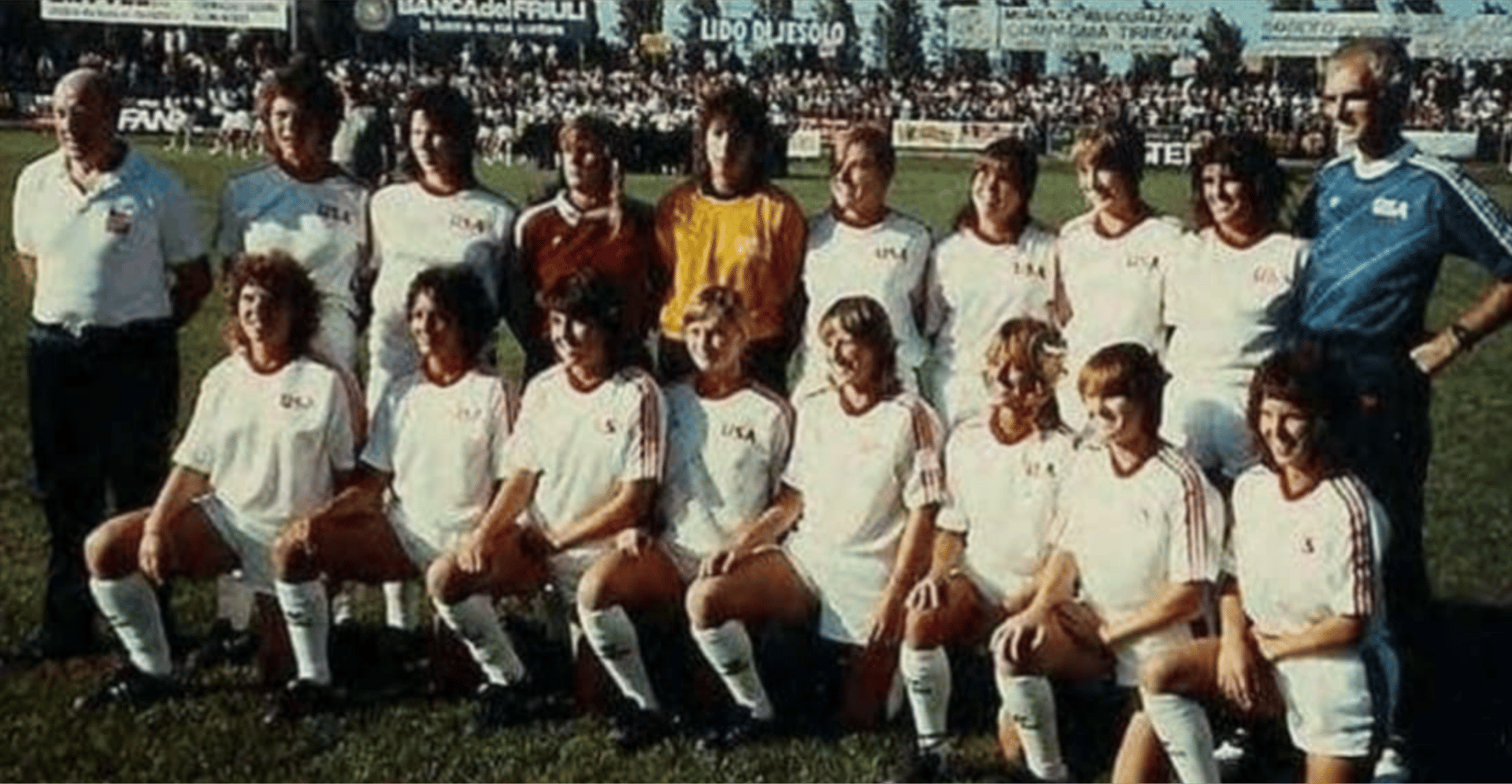
The 1985 U.S. women’s national team poses for a picture at the Mundialito tournament in Italy, where they played their first-ever match. (Image via Pam Cornell)
Welcome back to “I’m Curious!”
It has been another hard couple of weeks. We have seen yet another American lose their life due to bullets fired by an ICE agent. Snow has pressed most of the country into a bit of cabin fever, broken only by brief respites like dog walks or shoveling duty in the bitter cold.
And just like the snow, the tragedies pile into layers. They make themselves more complicated to address by freezing or crystallizing. They harden, making it so that lifting their burden feels like heaving a large stone.
The tragedies: the killing of Renee Good, the taking of five-year-old Liam Conejo Ramos, the killing of Alex Pretti—they pile trauma on us all, one after the other.
It’s a lot.
It can be too much.
In times like these, it is so important, critically important, to find a way to melt the cold layers of trauma. Maybe it’s in a book, or a hobby like knitting or journaling, a mental health tool like therapy or meditation. For me, it can come in the sports world and by telling its stories, and through writing this newsletter.
There will be at least one story in here from the Twin Cities. It is heartwarming, though, and a reminder of the best of who we can be.
And we’ll be diving in to highlight some overlooked history. The U.S. women’s national soccer team is the gold standard in soccer. Little girls dream of playing for the team. People of all ages have looked up to them for not just their soccer skill, but their rich history of advocacy for social justice and equal pay.
The team, though, had some extremely humble beginnings.
It’s a story that went untold for so long, of folks who have largely lived in anonymity but who should be household names as American sports pioneers.
And while plenty of other places in the sports world are also picking up the mantle and telling their stories, we’re doing our part at this here newsletter.
Today, we’ll be sharing the story of a U.S. women’s national team original, a member of the squad known as The 85ers.
Table of Contents
But first, here’s Peach!
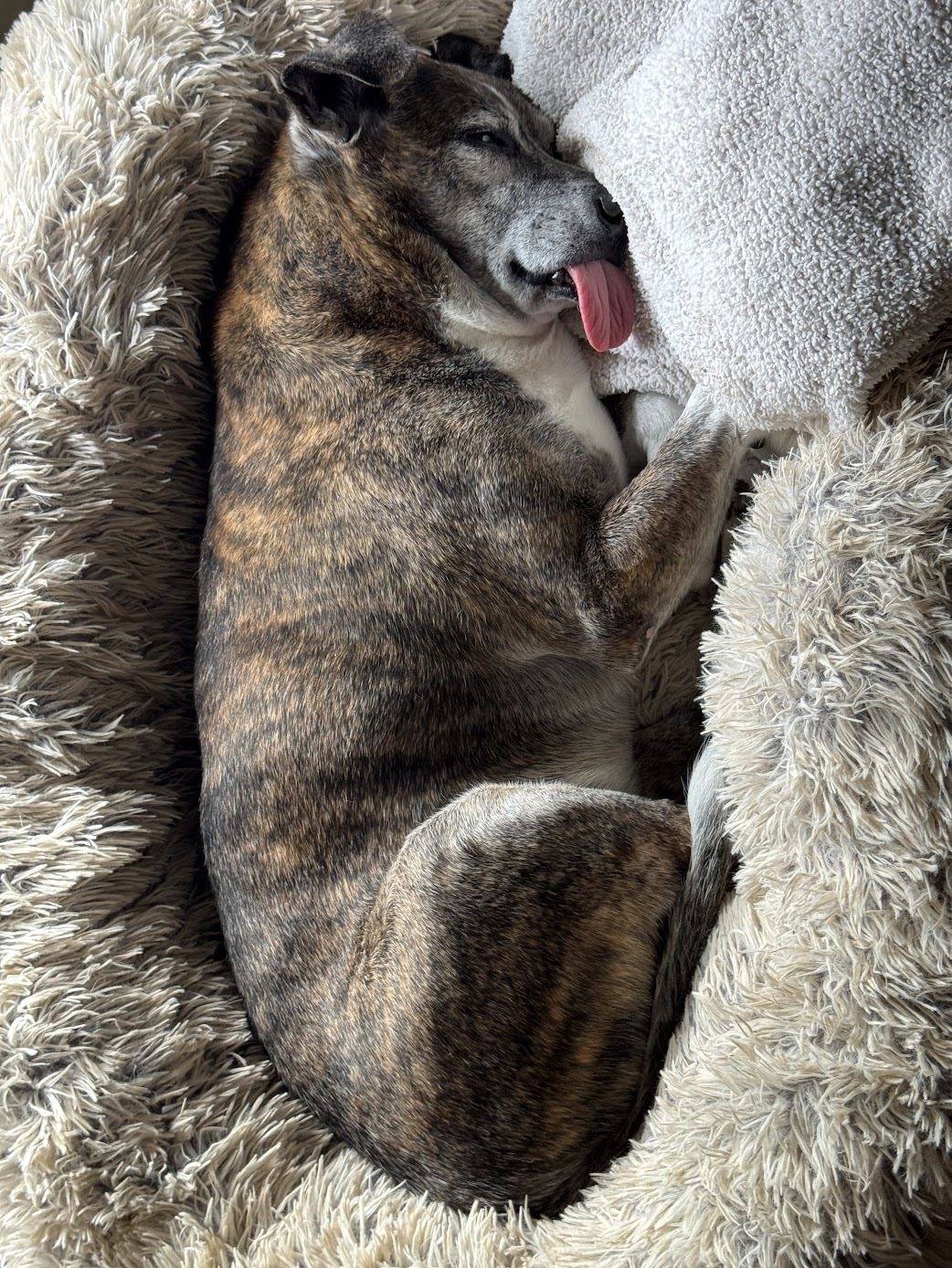
Peach, the mascot of this newsletter, dreaming. I wish I could tell you what she’s curious about in her dreams, but if I had to guess, it probably has to do with cheese.
The Most Curious Thing This Week
It’s the story of a soccer history-maker, hiding in plain sight.
Pam Cornell looks like any retiree living the dream. A couple of years ago, she and her husband Glenn wrapped things up, rented out their suburban Northern Virginia home and hit the road.
So many people in her day-to-day life may have known she was a local youth soccer coach, but they never realized until recently that not only did she also play high-level soccer, but she was also on the first-ever U.S. women’s national team.
The team that won the hearts of millions with its four World Cups and its win of its years-long fight for equal pay had quite the humble beginning. In the summer of 1985, a hastily-assembled squad of 17 young women, none of whom ever had the opportunity to play beyond college and who had never played together as a team, flew out to Italy to participate in the International Ladies Football Festival, also dubbed the Mundialito.
And Pam, still under her maiden name of Pam Baughman, was one of those 17 players to play for the first-ever U.S. women’s national team.
“I have a couple friends, new friends, that are just, you know, jaw dropped,” Pam said. “They can't believe they're actually meeting someone who played on the national team. And it's pretty—it’s pretty fun. They're just kind of shocked.”
The “85ers,” as they are often known, have earned far less acclaim than the national teams that followed. They didn’t get to play in a FIFA tournament, since FIFA did not set up a Women’s World Cup until 1991. And they remained largely overlooked until recent years, as modern pro women’s soccer teams have held events and created content to honor these soccer pioneers.
Most recently, Adidas partnered with the content studio Storied Sports to produce The 85ers, a podcast telling the story of how the first-ever U.S. women’s national team came together.
And over the course of seven episodes, the podcast highlights that so many of these players came to the game in spite of major obstacles, including gender discrimination and the lack of almost any investment or pipeline toward playing at a high level.
The full series is available wherever you get your podcasts, as well as on the Storied Sports YouTube page.
Pam grew up in Fairfax, Virginia, in the DC suburbs, and played the game at first as little more than a neighborhood hobby.
“Absolutely no care in the world,” Pam said. “I just wanted to play. I played—we played in the backyards. We played in the streets. I had people like in our neighborhood that were completely into it, too.”
It was a generally supportive community… other than maybe one cranky exception.
“We used to play in one neighbor's backyards, and the neighbor on the other side of that had his garage up against the fence line. And that was the goal: the fence, but sometimes we missed the goal and hit his shed or his garage and knocked the tools off the wall. And he would come into the yard and steal our soccer ball. So maybe he wasn't supportive, but everybody else was very supportive.”
But as she grew up, the opportunities began to emerge. As a standout youth soccer player in the years following Title IX’s enactment in 1972, she had opportunities to play at the collegiate level.
In 1981, she played for the University of Central Florida, one of the handful of top college soccer programs at the time. She was named an All-American, scoring 18 goals and adding 11 assists, but there was just one problem.
“I actually did terribly in school,” Pam said.
So it was back home to the DC area, where an opportunity emerged to play just down the street from her childhood home at George Mason University.
And Pam was an anchor for a Mason team that reached the NCAA College Cup final in 1983, putting herself on the radar as US Soccer leadership built toward assembling a national team.
Except, there wasn’t much infrastructure. In 1983 and 1984, US soccer named a women’s national team of top players, but it was a “paper team.” Players could be named to the team as an honor but they did not play any games together.
In 1985, things changed a bit. At the time, The US Olympic Committee held a nationwide sub-Olympic competition known as the Olympic Festival. For that year’s edition, athletes came to Baton Rouge, Louisiana, with women’s soccer set up as a regional competition.
Players knew they were competing for team recognition of some sort, but the team announcement was chaotic, and came with a bit of a surprise.
Pam was an alternate, but when a late injury struck another player, she was elevated to the main team. But with the infrastructure being so limited, she got the news in… shall we say… a non-traditional way.
“I was at work at JC Penney, and the reporter calls to tell me she wants to interview me because I've made the women's national team.”
She kept trying to correct the reporter that she was an alternate but the reporter was insisting that Pam had made the 17-player national team.
“She was arguing with me, and I was arguing with her. And she had called my house—my mom's house, my mom gave her the telephone number for JC Penney, and I said, ‘no, I'm not doing an interview.’ No one from US Soccer has told me I'm going to Italy,” Pam said.
It took a call to her college coach Hank Leung at George Mason, who was able to confirm with US Soccer that Pam was fully on the national team.
The U.S. women’s national team, ahead of a match at the 1985 Mundialito tournament in Jesolo, Italy, where the team played its first-ever matches. (Image via Pam Cornell)
From there, it was a whirlwind, as players quickly traveled out to Long Island for pre-tournament training.
“I was taking a summer college course, and it was the last course I needed to take to graduate,” Pam said. “I had to write my final and then mail it to the professor.”
The week in Italy was unlike anything most of the team had ever seen. It didn’t matter that they had never played together before, or that they were wearing hand-me-down men’s jerseys. They had made it there.
“They were former men's jerseys, and so you could tell that they were used, they weren't, you know, just used one time. They were well used jerseys,” Pam said.
“But again, you know, we didn't care. I didn't care. Just give me that jersey with USA on it. It's very special.”
She’s not even entirely sure what number she wore.
“I think I started with 18. I always have to ask. It was either 13 or 18. I think it was 18. Might have been 13, I don't even know.”
Being the first to wear any of those numbers would mean any number of legends followed her lead. Icons like Kristine Lilly and Alex Morgan have worn number 13 for the U.S. team, while 18 has moved on to be a number for many great goalkeepers, including Saskia Webber and Hope Solo.
And it may feel completely foreign in a time where the U.S. has developed rifts with even its longtime allies, but the fans were extremely excited and cheered on the ragtag, underdog Americans.
It’s a core memory she has of the trip.
“Just that special treatment of the fans, just wanting to be with us, be near us, talk to us, touch us, get our autograph. Just very excited to meet us, like in the hotel we were staying at, just people, just wanting to see the American women soccer players. We were a hit for sure.”
It actually left a relic that still remains with the national team today. Before every game, in the pregame huddle, players chant “Oosa! Oosa! Oosa! Aaaah!”
It came from the 85ers, who used it as their chant after hearing Italian fans chant “Oosa!” in an effort to chant “U-S-A!”
Pam’s teammate Stacey Enos told TV station WLOS in Asheville, North Carolina ahead of a 2023 event held by local club Asheville City that “we were on the field with our hands over our hearts for the first time as the U.S. Women's National Team singing the Anthem, and the 'OOSA' was just really building as it ended,” adding, “it didn't end, the chant just got louder and louder. We just realized it was an outpouring of support. So the Italians gave us the 'OOSA' chant and stood behind us."
Through the years, the team never stopped doing the chant.
The Americans did not win a single game at the 1985 Mundialito, losing three out of four and tying a fourth. But history had been made and the team was still able to score three goals.
Several 85ers hung on long enough to be part of future national teams. Pam’s teammate Lori Henry was a defender on the U.S. team that won the 1991 World Cup, and fellow 85er Michelle Akers went on to play as an attacking midfielder and forward on both the 1991 team and the team that won the 1999 World Cup.
The journey was a bit shorter for Pam, who played her last game for the national team a year later, but she was still able to score a goal for the US national team, doing so in a game in 1986 against Canada.
And she still notched one more major accolade before hanging up the boots: after missing the first part of training camp in August to play for the national team, she came straight back to George Mason and led the team to win the 1985 NCAA College Cup in November.
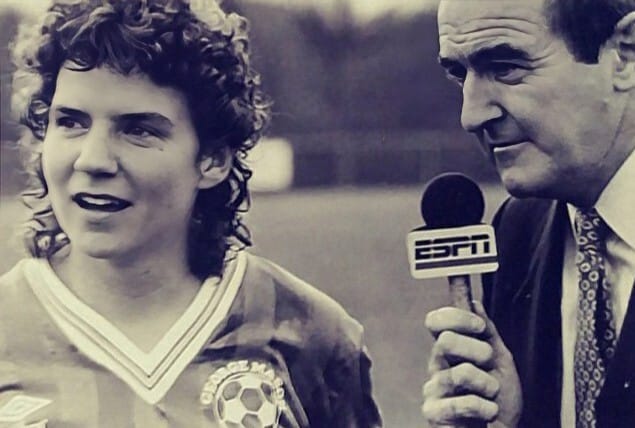
Pam being interviewed by ESPN reporter Seamus Malin during George Mason’s 1985 championship run. (Image via Pam Cornell)
And then she capped a whirlwind few months in January 1986 by getting married. Even now, 40 years on, she’s reaping the benefits of such a busy stretch.
“That was, you know, celebrating 40 years, also this past year with that [Mason] team. So I got to do that this past summer. And so that was in November that we won the championship. And then January is when Glenn and I got married. So I was just on a roll.
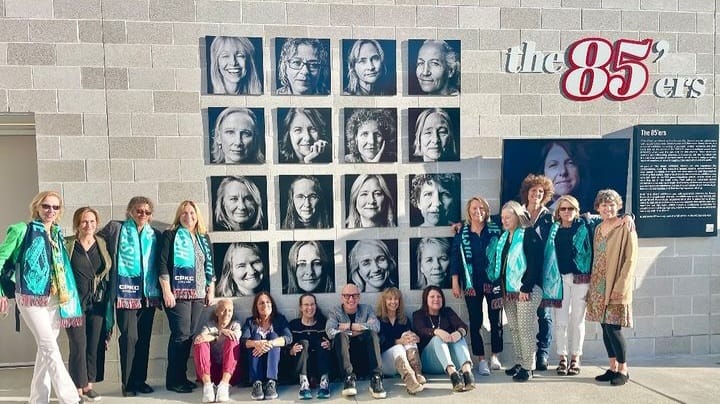
Members of “the 85ers,” the first U.S. women’s national soccer team, pose in front of a commemorative wall of photos installed at CPKC Stadium in Kansas City, Missouri, in 2024. (Image via Pam Cornell)
In the years that followed, Pam still played on amateur teams and hung around the game by coaching at the youth level.
But most of her focus went into raising her two sons. She says her way of preserving her soccer history is by giving them each a relic of her national team career.
“I have my jerseys, but I've given them to my I have two sons, and so they each got a jersey,” Pam said. “They wear them on Fourth of July. If they go to a national team game, men or women's, they'll put the jerseys on.”
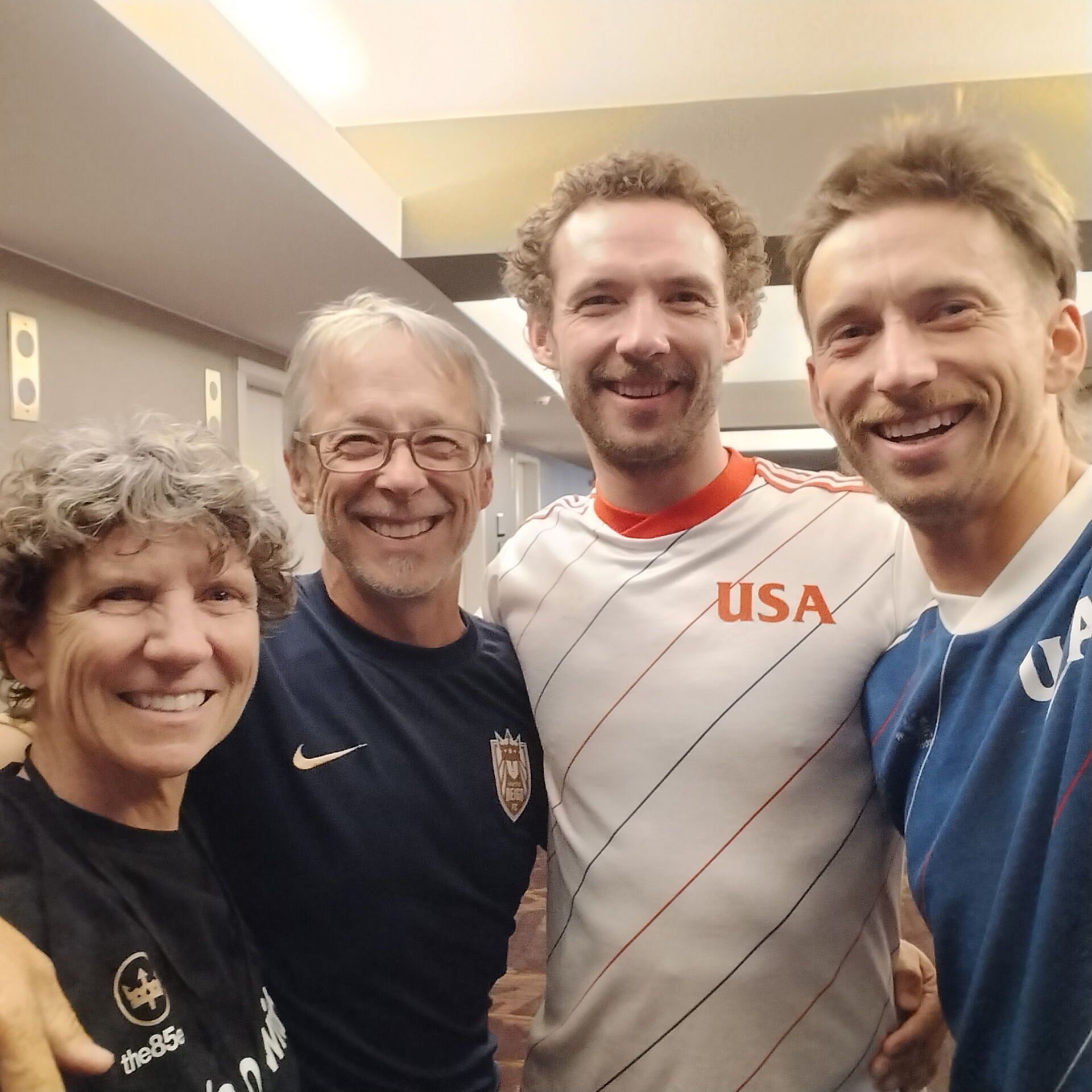
Pam with her husband and two sons—the two of them are wearing her original jerseys (Image via Pam Cornell)
And Pam and her husband Glenn have swapped the soccer pitch for a much more expansive version of the great outdoors. They are avid hikers—Pam has hiked the Appalachian trail three times and is planning on a fourth go-round this spring, which will be Glenn’s first.
And they are also full-time van lifers, living wherever the road takes them but skewing toward specialized meetups.
“We're currently at—it's called a an RVR. It's a Rolling Vegan Rendezvous,” Pam told me when we chatted earlier this month. “We're in Quartzsite, Arizona, with 40 people all living in their rigs all around us, and we're having a blast.”
She told me that they have been able to see every state in the lower 48 in their van and that it has no shortage of nice features.
“The most important thing to me is my refrigerator and my stove, and we have a shower and a bathroom. We have everything you need.”
It has been a long and winding road for Pam, both literally and figuratively, but now, more than 40 years on from her role in American sports history, the potholes are clearing up, the bumpy ride is getting smoother, and the American soccer community is giving 85ers like Pam the recognition she deserves before she rides off into the sunset.
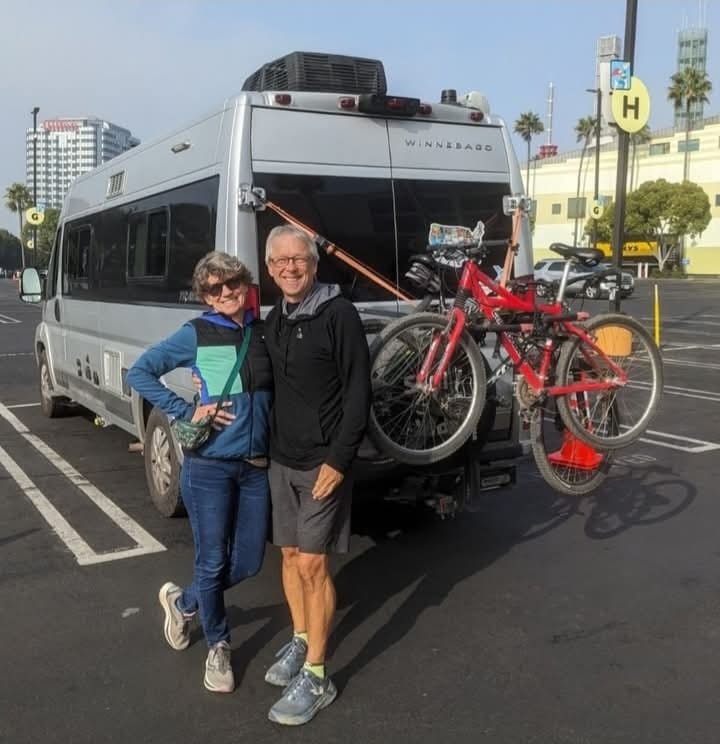
Pam and her husband Glenn, in front of their van. (Image via Pam Cornell)
My Reporting
MS NOW
The aftermath of Saturday’s tragic killing of 37-year-old nurse Alex Pretti by a band of ICE agents showed how quickly and firmly the people of the Twin Cities have stuck together. In the face of weeks of egregious overreach and an all-out effort to sap their freedom and their joy, they have built distribution networks for food and essentials, they have monitored ICE agents and in their most powerful act to date, they went on strike Friday.
Over a thousand businesses in the Twin Cities area, as well as some of Minnesota’s largest museums and public venues, closed their doors Friday in the first cities-wide general strike in the U.S. in 80 years.
We had the chance to speak to the owner of one of those establishments, a bar owner named Wes Burdine. His bar, the Black Hart of Saint Paul, is an LGBTQ+ bar and a soccer bar, frequently drawing crowds from MLS’s Minnesota United games, as the team’s stadium, Allianz Field, is around the corner.
The venue hosts game watches and drag shows and all sorts of performances and parties, in a powerful reminder of how Minnesota has become a sanctuary for immigrants and LGBTQ+ people, even before the Trump administration’s attacks on the city.
But the mission of the Black Hart has a particular resonance in the last few weeks. Because in the killing of Renee Good earlier this month, one detail stood out to me but was largely overlooked.
As she tried driving away in the car with her partner, you could see a familiar sticker for followers of pro women’s soccer in the U.S.: a sticker for the NWSL’s Kansas City Current.
Idk if anybody in soccer world has noticed this, but the vehicle Renee Good was driving when the ICE agent shot her had a sticker on it for the NWSL's Kansas City Current, among others. (Photo by Elizabeth Flores of the Minnesota Star-Tribune)
— Roey Hadar (@roey.bsky.social)2026-01-07T22:51:30.280Z
ICE’s killing of Good has sparked protests and calls for justice around the world. But even close to home in the Twin Cities, the kind of bar tailor made for her shut its doors on a rare busy night in a quiet time of year.
A local queer soccer bar closing to protest the killing of a local queer soccer fan. But the Black Hart closed to strike for justice for Renee Good and for fellow Minnesotans suffering and living in fear of their own government. And didn’t think twice about it.
At work, our host Jen Psaki interviewed Wes Burdine, the Black Hart’s owner, in a powerful and emotional interview.
“It just shows the fact that you have over a thousand businesses that are shutting down, small businesses that are struggling, it shows you how important and historical this moment is, and so it’s something I’m proud to do,” Burdine said.
Burdine told us about his experience at Friday’s march in Minneapolis, where temperatures barely broke -10 degrees Fahrenheit.
“They said it was cold, but all I felt was love out there,” Burdine said.
After the interview, he posted about the reach the conversation had. People were calling in from all over.
You guys, a woman from Columbus, OH & a guy from Lake Charles, LA just called the bar to ask how to support the bar and tell me I’m an inspiration and my dudes I’m not emotionally stable enough to handle things like that
— Wes Burdine (@wesburdine.bsky.social)2026-01-24T03:09:02.253Z
To me, it was such a powerful reminder of how much people want to help and spread kindness. From Wes and his bar to people calling him up to the tens of thousands of people in the streets marching or helping keep families together, these times are bringing out some of the best humanity has to offer.
The entire Jen Psaki interview with @wesburdine.bsky.social from last night lives here in 2 parts. @jenpsaki.bsky.social opens and contextualizes the segment by noting the Kansas City Current sticker on Renee Good's car and goes into the connection of soccer in the broader Twin Cities region (1/2)
— Douglas Reyes-Ceron (@dreyesceron.bsky.social)2026-01-24T21:18:20.335Z
Part 2 which leads to Wes talking about the support he and others have gotten during the Friday strike and broadly through this time of crisis (2/2)
— Douglas Reyes-Ceron (@dreyesceron.bsky.social)2026-01-24T21:18:20.336Z
Something Good I Ate
I’m dipping into the archive this week to honor a good meal from the past. This one has a special place in my heart as the meal that helped get me out of a really bad funk.
On our trip to the Pacific Northwest in 2024 (shoutout Edition 13 of this newsletter!,) we were in Portland when one morning I received word that I and many others were being laid off with our last day coming a few weeks later.
It was a particularly rough time to receive the news, as I was both on vacation and sick on vacation. My then-fiancée (and now-wife) and our friends helped convince me to step away from the panic scrolling of LinkedIn to get some lunch.
We headed to a food truck lot in downtown Portland and each made our own pick from one of the many options. I went for Stretch the Noodle, a Chinese food cart that, as you might expect, specializes in hand-pulled noodles.
I ordered the Biang Biang Noodles, a dish with thick, wide noodles served with a spicy mala sauce and topped with sesame seeds.
If you haven’t had anything prepared with mala before, it is a unique peppercorn and chili seasoning in Sichuan Chinese cuisine that causes a numbing feeling in the mouth alongside the usual spiciness.
These noodles numbed me inside and out, warming me up on a chilly fall day in Portland and helping me feel just a little bit better after receiving some really bad news.
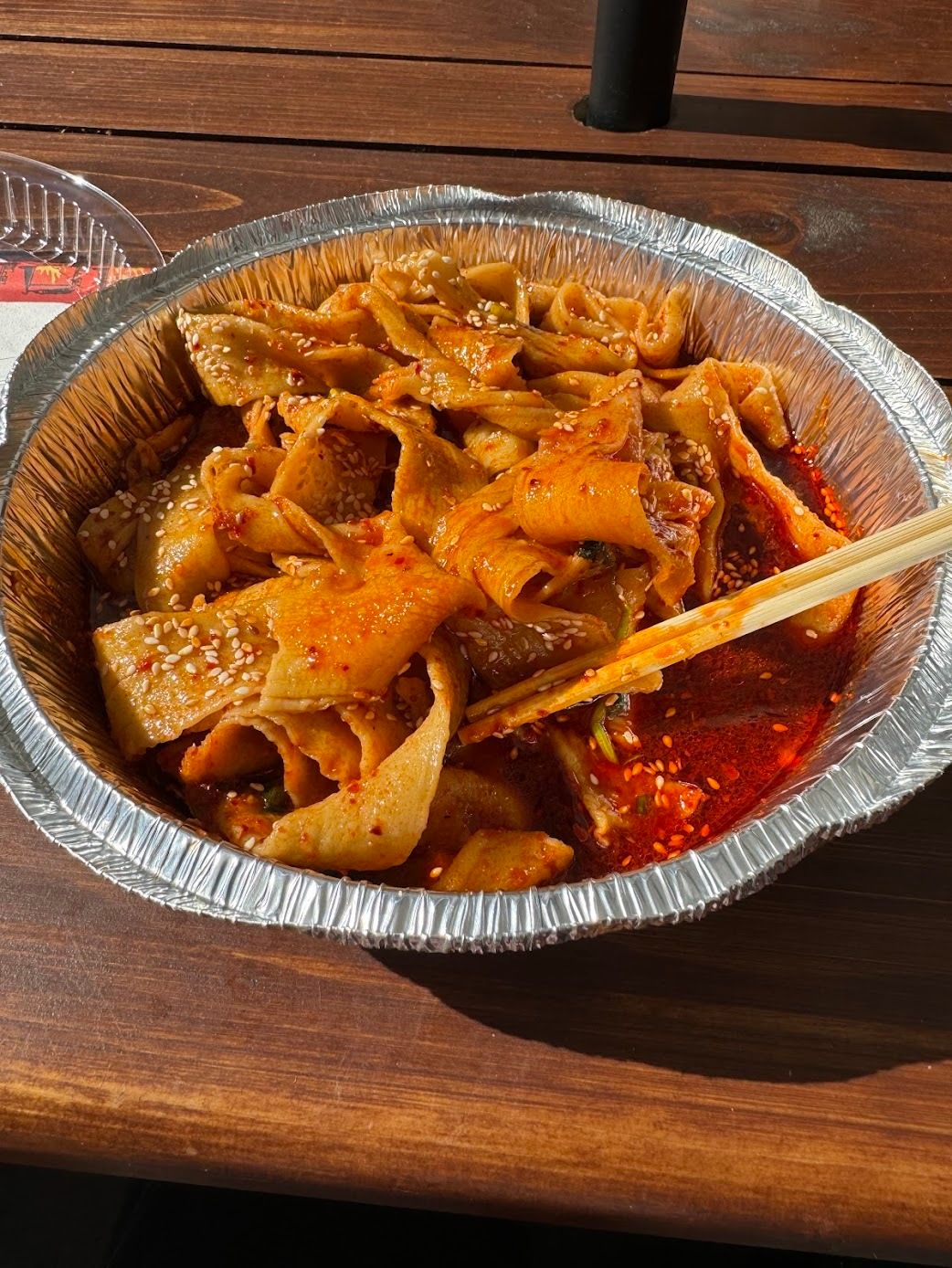
Biang Biang noodles from Stretch the Noodle, a food truck in Portland, Oregon, September 27, 2024.
Just a note: Any work here or opinions I express are solely mine, and do not reflect the views of my employer, my coworkers, or anybody else affiliated with me. The newsletter is not monetized in any way and everything in here is written and reported with my own resources on my own time outside of my working hours unless specifically noted otherwise. “I’m Curious” is just for me, the author, and for you, the reader. Thank you for reading. I’m glad you’re here.